WordPress powers more than 43% of all websites on the internet, making it the most widely used Content Management System (CMS) in the world. From personal blogs and business websites to enterprise platforms and eCommerce stores, WordPress has proven to be a reliable and flexible solution for managing digital content.
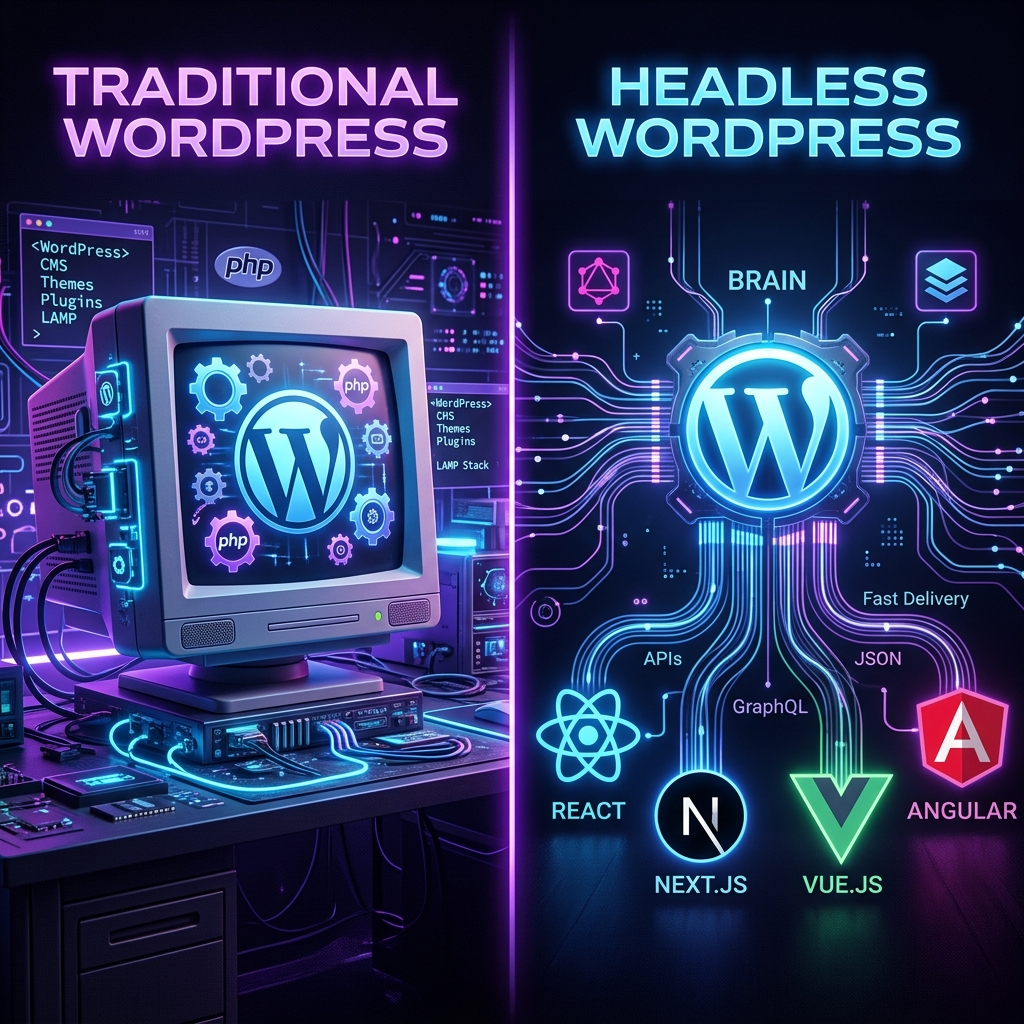
However, as modern web development evolves, businesses are increasingly exploring Headless WordPress as an alternative architecture. While traditional WordPress combines both the frontend and backend into a single system, headless WordPress separates content management from the presentation layer, allowing developers to build faster and more flexible applications.
Understanding the difference between Traditional WordPress and Headless WordPress is essential when deciding which approach best suits your website or application.
In this guide, we will explore:
- What Traditional WordPress is
- What Headless WordPress means
- Key differences between both approaches
- Advantages and disadvantages
- When businesses should choose each architecture
What is Traditional WordPress?
Traditional WordPress refers to the standard architecture where the frontend and backend are tightly integrated within the same platform.
In this setup, WordPress manages:
- Content creation
- Database storage
- Website layout and design
- Content rendering for visitors
When a user visits a page, WordPress processes the request through PHP, retrieves data from the database, and renders the page using a theme.
Components of Traditional WordPress
A typical WordPress setup includes:
1. WordPress Dashboard (Backend)
The admin panel where users manage posts, pages, plugins, and themes.
2. WordPress Database
Stores content, settings, user information, and media data.
3. Themes
Themes control the design and structure of the website.
4. Plugins
Plugins extend functionality such as SEO optimization, eCommerce, forms, and security.
5. Frontend Rendering
WordPress uses PHP templates and themes to display content directly on the website.
This architecture makes WordPress extremely beginner-friendly and ideal for businesses that want to launch websites quickly.
Advantages of Traditional WordPress
Traditional WordPress remains the most popular choice because it offers several benefits.
Easy Setup and Management
One of the biggest advantages is simplicity. WordPress allows website owners to create and manage content without deep technical knowledge.
With page builders and themes, businesses can launch websites quickly without needing a full development team.
Large Plugin Ecosystem
WordPress has thousands of plugins that extend functionality, including: SEO optimization, security tools, eCommerce integration, analytics tracking, and performance optimization.
These plugins make it easy to build powerful websites with minimal development effort.
Cost Effective
Traditional WordPress websites are generally less expensive to build and maintain compared to custom applications.
Small businesses and startups often choose WordPress because it provides enterprise-level functionality at a relatively low cost.
Strong SEO Capabilities
WordPress is highly optimized for search engines, especially when combined with SEO plugins. Features like structured content, customizable URLs, and SEO metadata make it easier to rank on search engines.
Limitations of Traditional WordPress
While traditional WordPress works well for most websites, it does have certain limitations.
- Performance Constraints: Because WordPress generates pages dynamically using PHP and database queries, large or high-traffic websites may experience slower performance.
- Limited Frontend Flexibility: Developers working with modern frameworks sometimes find WordPress themes restrictive.
- Scalability Challenges: For highly complex applications, scaling a traditional WordPress website may require additional optimization.
These challenges led to the development of Headless WordPress architecture.
What is Headless WordPress?
Headless WordPress is a modern architecture where WordPress is used only as the backend content management system, while the frontend is built using separate technologies. Instead of using WordPress themes to display content, developers build the frontend using frameworks like: React, Next.js, Vue, or Angular.
Content is delivered through APIs such as the WordPress REST API or GraphQL.
In this architecture, WordPress becomes a content engine, while the frontend application controls how the content is displayed.
How Headless WordPress Works
Headless WordPress separates the system into two layers.
Backend (WordPress)
The backend still manages: content creation, media management, user roles and permissions, and database storage. Content editors continue to use the WordPress dashboard.
API Layer
Content is delivered through APIs such as the REST API or GraphQL. These APIs allow external applications to fetch content.
Frontend Application
Developers build the frontend using modern JavaScript frameworks. The frontend retrieves content from WordPress and displays it dynamically to users.
Benefits of Headless WordPress
Headless WordPress offers several advantages for modern digital platforms.
- Improved Performance: Modern frameworks like Next.js can generate static pages and deliver them through Content Delivery Networks (CDNs), resulting in faster load times.
- Greater Development Flexibility: Developers can build highly customized user experiences using modern technologies.
- Omnichannel Content Delivery: Headless architecture allows content to be delivered across multiple platforms, including websites, mobile applications, smart devices, and digital displays.
- Better Scalability: Large organizations benefit from headless architecture because frontend and backend systems can scale independently.
Challenges of Headless WordPress
Despite its advantages, headless WordPress is not always the best choice for every project.
- Higher Development Complexity: Headless architecture requires experienced developers who understand API integrations and modern frameworks.
- Increased Development Cost: Building separate frontend and backend systems typically requires more resources.
- Plugin Compatibility Issues: Many WordPress plugins are designed for traditional architecture and may not work seamlessly in headless setups.
Key Differences Between Traditional WordPress and Headless WordPress
Understanding the core differences helps businesses choose the right architecture.
- Traditional WordPress combines both frontend and backend into a single system. It uses themes and PHP templates to render web pages directly.
- Headless WordPress separates the backend from the frontend. WordPress manages content, while external frameworks control the user interface.
- Traditional WordPress is easier to set up and manage, making it ideal for blogs, business websites, and small eCommerce platforms.
- Headless WordPress offers greater flexibility and performance but requires more advanced development expertise.
- Traditional WordPress is generally more cost-effective, while headless solutions are better suited for large-scale applications.
When Should You Use Traditional WordPress?
Traditional WordPress is ideal when:
- You need to launch a website quickly
- Your team is not highly technical
- Budget is limited
- The website is primarily content-driven
- You want to rely on plugins and themes
Examples include: Corporate websites, Blogs, Marketing websites, and Small to medium eCommerce stores.
When Should You Use Headless WordPress?
Headless WordPress is better suited for projects that require:
- High performance
- Advanced user experiences
- Integration with multiple platforms
- Custom frontend applications
- Scalability for large digital ecosystems
Examples include: SaaS platforms, Mobile applications, Enterprise websites, Large content platforms, and Multi-channel digital systems.
Hybrid WordPress: The Best of Both Worlds
Some organizations adopt a hybrid architecture, where WordPress serves both traditional pages and API-based applications.
For example, marketing pages run on traditional WordPress themes, while web applications run on modern frameworks connected through APIs.
Final Thoughts
Both Traditional WordPress and Headless WordPress offer powerful capabilities, but they serve different purposes.
Traditional WordPress remains the best choice for most websites because it is easy to manage, cost-effective, and supported by a massive ecosystem of themes and plugins.
Headless WordPress, on the other hand, provides unmatched flexibility and performance for complex digital platforms that require modern frontend frameworks and multi-channel content delivery.
By understanding the differences between these architectures, businesses can make informed decisions and build digital platforms that are both efficient and future-ready.